
Lambeth's street drinking order runs to midnight on 19 October; the renewal survey closed on 15 October and no decision is published yet. What the powers allow.
Lambeth Council is asking residents whether it should keep its powers to stop people drinking in public. The borough-wide order that gives police and council officers those powers expires at midnight on Monday 19 October. The survey on renewing it closes on Thursday 15 October (Lambeth Council).
Updated 19 October: the survey has closed. On the morning of 19 October the council had published no decision to extend the order, either on its newsroom or on its list of officer decisions. We will update this page when it does.
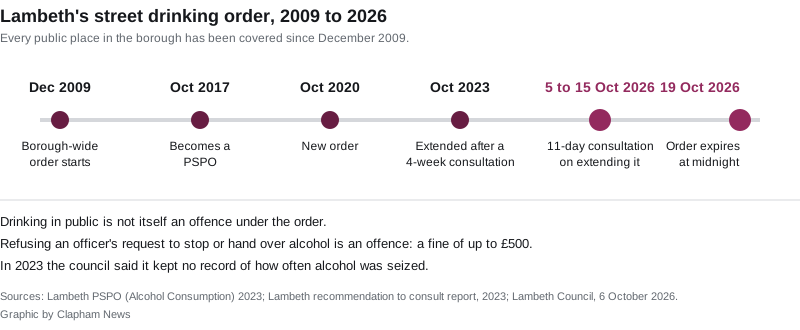
The consultation opened on Monday 5 October. That gives residents 11 days to respond. When the council last renewed the order, in 2023, the survey ran for four weeks, from 25 August to 22 September (Lambeth Council, 2023 consultation).
The council’s consultation site showed 201 participants on the morning of 9 October (Lambeth Have Your Say).
What the order does
The order is a Public Spaces Protection Order, made under the Anti-social Behaviour, Crime and Policing Act 2014. The current one came into force on 20 October 2023 (Lambeth Council, the 2023 order).
It covers every public place in the borough: streets, parks, estates and Clapham Common included. Licensed premises such as pubs are exempt. In practice it means:
- Drinking in public is not an offence in itself. The order says so in terms.
- A police officer or authorised council officer can tell you to stop if they reasonably believe your drinking is, or is likely to be, linked to disorder, nuisance or annoyance.
- They can also make you hand over the alcohol and the container.
- Refusing without a reasonable excuse is an offence, punishable by a fine of up to Level 2 on the standard scale.
The council’s 2023 report put the Level 2 maximum at £500. It said a fixed penalty of £100, paid within 28 days, could be offered instead of prosecution (Lambeth Council, recommendation to consult, 2023).
Why the council says it is needed
The council’s release lists four harms it says street drinking still causes:
- intimidation or inappropriate behaviour towards the public, sometimes from groups gathering in particular places
- loitering and aggressive begging outside shops and businesses
- litter on estates, residential roads, parks and town centres
- risks to the health of people who drink on the street often, and to others
Cllr Jonathan Bartley, Cabinet Member for Safer, Thriving Neighbourhoods, said the powers needed to be “proportionate and continue to meet the needs of our communities”. He said the council wanted to hear “whether they think these powers continue to be needed” before any decision is taken.
The evidence linked is from 2023
The release says the council’s evidence base sets out its full rationale. The evidence document it links to is the one from the last renewal, titled “Street Drinking in Lambeth 2020-2023” (Lambeth Council, evidence base). We could not find newer figures published with this consultation.
The 2023 report gave these numbers:
- 625 alcohol-related and street drinking incidents recorded by the council’s Public Protection team, April 2021 to mid-August 2023
- 505 alcohol-related and street drinking calls to the Metropolitan Police, July 2022 to June 2023
- 5,000 alcohol-related incidents attended by London Ambulance Service, July 2020 to June 2023
- 1,024 of those, about 20%, in Waterloo and South Bank
The same report named Brixton Windrush as the ward with most complaints to the council. Most alcohol-related police calls came from Waterloo and South Bank.
It also said the council and the Met did not record how often alcohol was seized. That is the power officers use most, so there was no measure of how often the order was actually used.
What it means for you
If you have a view, the survey is on the council’s Have Your Say site until Thursday 15 October.
If the order is renewed, nothing changes day to day. A drink on Clapham Common or outside a pub stays legal unless an officer links it to nuisance or disorder and you then refuse to stop.
If it is not renewed, officers lose the power to make you stop or hand over alcohol from 20 October. Other powers, such as dispersal orders, would remain.
We will report the decision when the council publishes it.
Sources
- Lambeth Council, “Lambeth asks for views on maintaining powers to address problems associated with street drinking”, 6 October 2026, for the consultation, the closing date, the four harms and Cllr Bartley’s comments.
- Lambeth Have Your Say, Alcohol Consumption PSPO Extension in Lambeth 2026, for the survey dates (5 to 15 October) and the participant count.
- Lambeth Council, Public Spaces Protection Order (Alcohol Consumption) 2023 (PDF), for the wording, the start date and the expiry at midnight on 19 October 2026.
- Lambeth Council, recommendation to consult report, 2023 (PDF), for the history of the order since 2009, the fine and fixed penalty, the 2021 to 2023 figures and the seizure records.
- Lambeth Council, 2023 consultation page, for the 2023 consultation dates.
Have your say